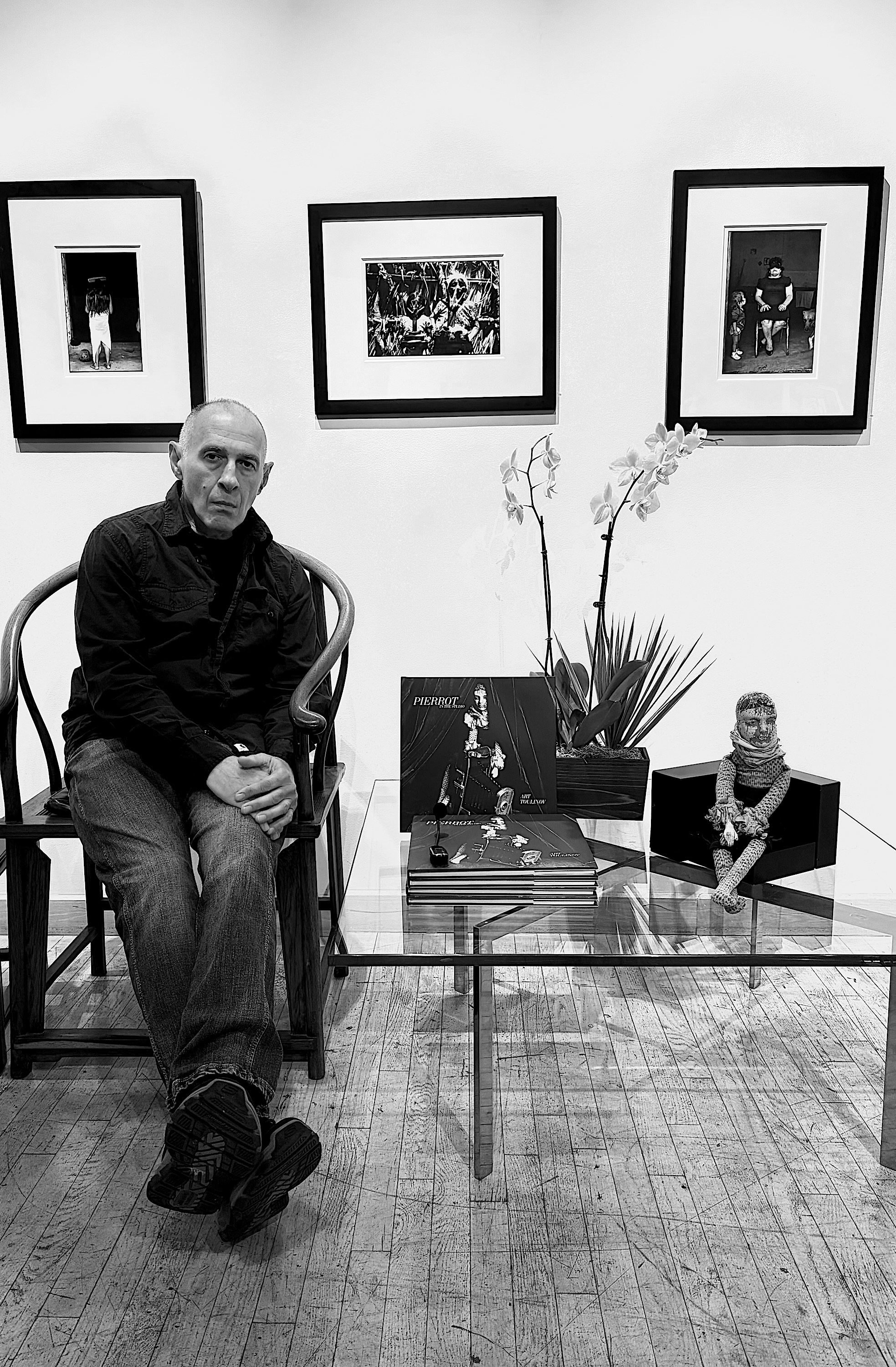
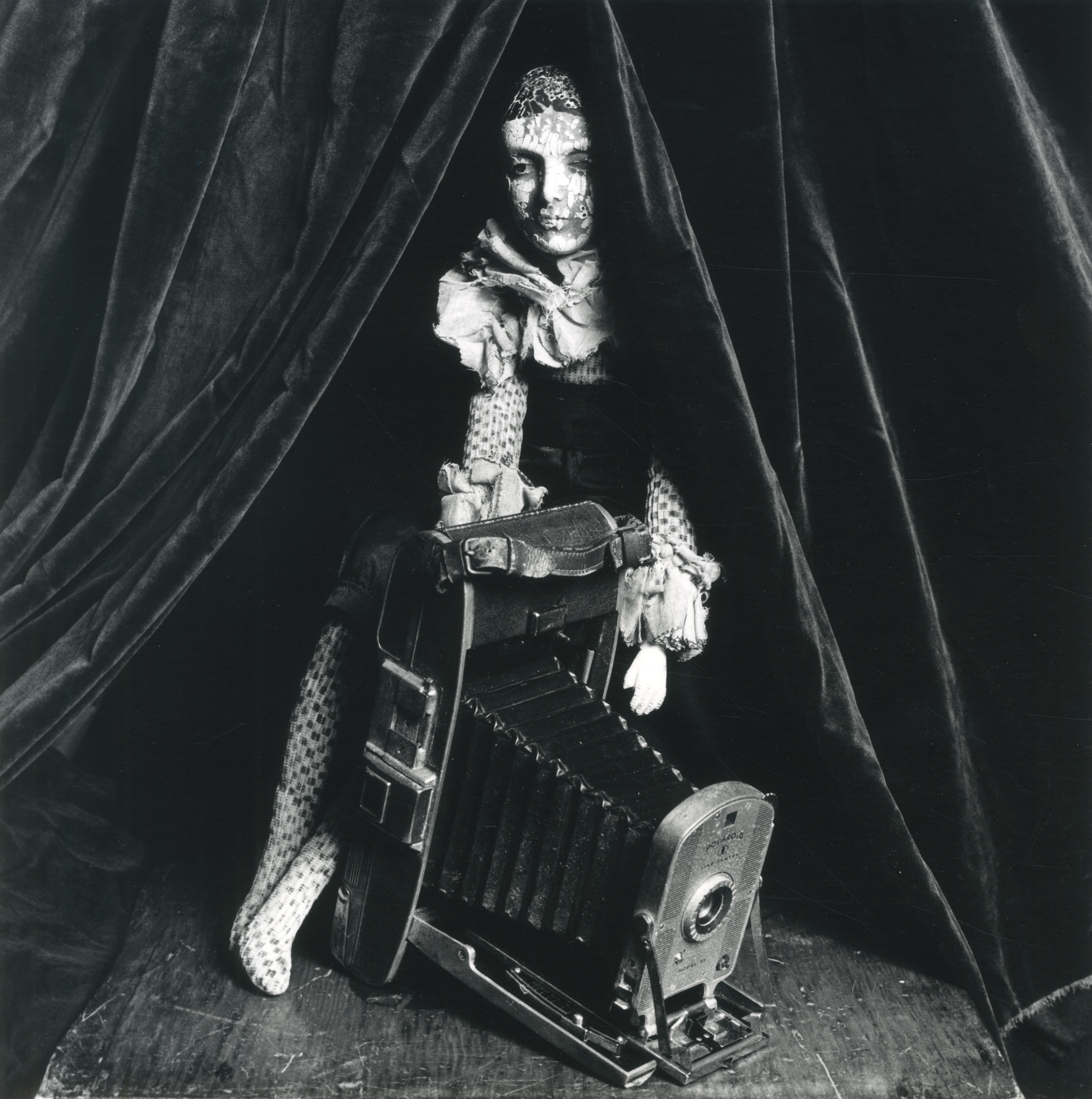
The early morning sky promised a beautiful day, as the vendors set up their booths in the vacant parking lot next to an old Serbian church on 25th Street, the place where they had moved after the famous Antiques Garage closed in 2014. For twenty years, an incredible cast of characters sold their eclectic wares there to artists like Andy Warhol, celebrities and models, and the general public. As he had for many years, Art Toulinov, who found people from all walks of life to photograph, would scour the New York City Flea Market every weekend for props to help tell a story in his studio.
As he wandered through the aisles of booths, greeting the vendors he knew and looking for fresh inspiration, he passed by a table piled neatly with old linen tablecloths and napkins. At the back edge of the table, two puppets, one male and one female, were propped up in a cobalt blue mesh hatbox, decorated with gold stars and moons. An elderly woman with large glasses was behind the table stacking the last of the napkins. When she glanced up to greet him, she looked like a female version of Harry Potter, and Toulinov had the sense that something magical was about to happen. When he asked her if he could take a closer look at the puppets, he was surprised to note that she seemed almost protective of them.
The male puppet drew him in, as if something ancient yet familiar was staring back at him. They are very old, she told him. She’d had them for a long time and always wanted them to live in an artist’s studio. She talked about them in an intimate way and clearly was going to wait for the right buyer to come along. He asked how much they cost. and, in obvious turmoil about parting with them, she barely whispered one hundred dollars.
At the time, that was a lot of money for Toulinov to spend on what might yield a photo or two. He told her he would think about it and come back the next day to let her know if he would be getting them. But he felt he had no choice and worried all night if they had already been sold.
Toulinov was born between two rivers in Tuapse, Russia, a seaport on the Black Sea. From a young age, he was sculpting, painting and drawing. After graduating from Moscow State University with a degree in law, he worked as a lawyer. During that time, he founded a small body building gym. He had begun weight training when he was 19, and there were no body building gyms around. He practiced law and kept the gym going, until he immigrated to the United States in 1991 and later became a United States citizen.
Although he was unable to practice law here, he did continue his work as a fitness trainer, not realizing then that he was training his eye for the photographic work he would make in the future.
He first picked up a camera in 1993, but it wasn’t until 1997 that photography became his passion, and his work took a serious bent. He had no formal art training, but he had wonderful mentors through the years that taught him a great deal. When he told his friend, the photographer Marcus Leatherdale, about his improvised photo studio and frustration with the rectangular format, Leatherdale invited him to his studio in Dumbo and introduced him to the Hasselblad square format, giving him his extra camera to try out. Leatherdale, a renowned photographer had been a protégé of Robert Mapplethrope. This is what Toulinov was looking for all along.
When he felt comfortable using the camera, Leatherdale invited him to try shooting in his Dumbo studio, showed him how to use the strobe and volunteered to be his model. Toulinov never looked back.
Ever since, he has worked exclusively in the studio, using a black backdrop to create a small theater for the objects and people that he portrays. He was inspired to work in this particular way by the icons that fascinated him growing up in Russia, and by the classical literature of his motherland. It was natural to create stories with his images, stories that evolved over the years to express emotions and experiences common to us all. He still shoots only black and white film with a Hasselblad camera designed in 1948 and prints the images himself in a refined silver gelatin format.
The puppets did seem to have a story to tell, so Sunday morning, money in hand, he found the vendor again busy putting the linens on the table. The puppets weren’t there. His greatest fear was realized. Perhaps it wasn’t meant to be. When she spotted him, she turned back toward her husband who was sitting in a chair at the back of the tent and said, “This is the young man I was telling you about.” And then she pulled the box with the puppets out from under the table. Toulinov hadn’t noticed the magical design of gold stars and moons on the box the day before. He quickly handed her the money, telling her how grateful he was that she hadn’t sold them.
She told him that the box came with the puppets, that someone had custom made it for her to keep the puppets protected. “After you left, I thought I should have given them to you yesterday and tell you to bring the money when you were able.”
“I feel I have a real treasure,” Toulinov told her, hoping she would trust the puppets had found a good home.
Toulinov took the puppets to his Bushwick studio, with no idea of how he would work with them and expecting they would yield only a few pictures. As he studied them, the male puppet seemed to be carrying a lot of sorrow, the weight of his past that kept him from being happy.
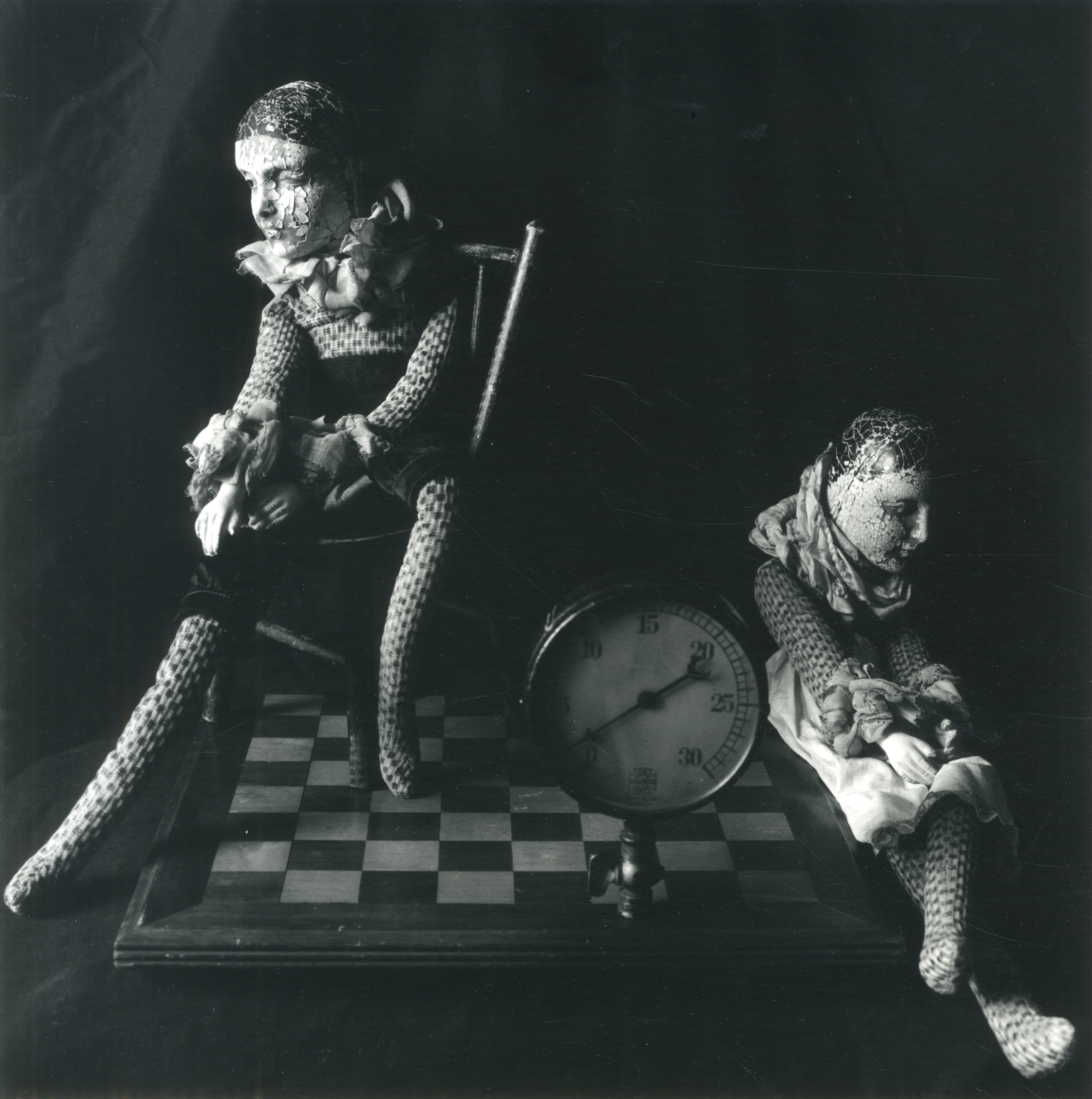
As he began working with the male puppet, it increasingly reminded him of himself – balding, cracked, beat up, and not a young man anymore. The puppet gave him freedom to portray his emotional struggles and those of others in a deeper way and evoke his persistent themes of isolation and loneliness, nostalgia, morbidity, the struggle with ambition and the irrelevance of labor to success.
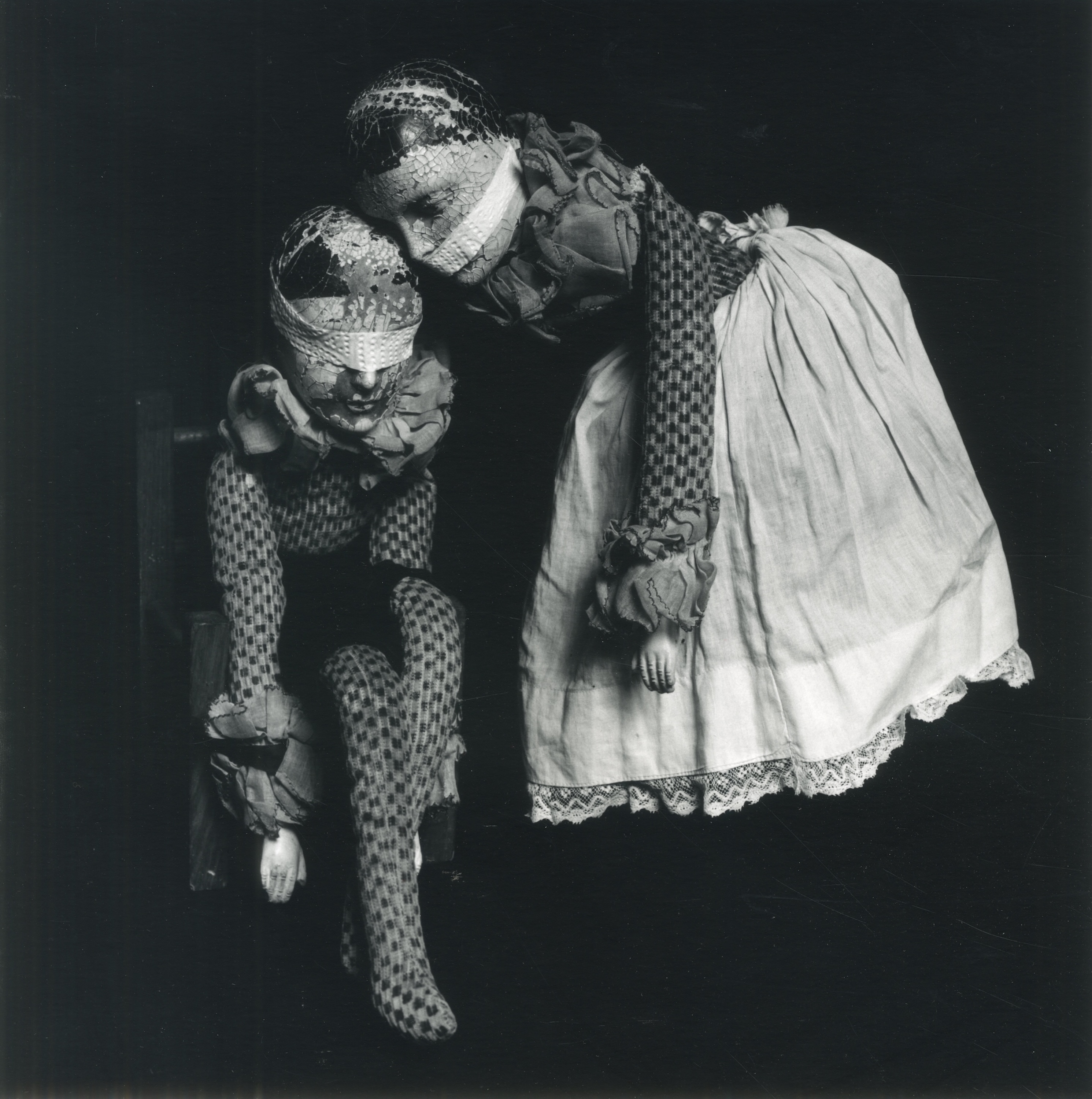
Finally, he turned to the female puppet and found something different and surprising being expressed. A different emotion was elicited working with her. Angst disappeared, and he felt charged up. Though the puppets looked much alike, almost like twins, the female puppet was more feminine. Where Pierrot was more beat up, time had spared her from damage. Somehow, she seemed elegant, more optimistic and smarter.
Toulinov began exploring the relationship between the two puppets: their love for each other, their misunderstandings, their inability to communicate or reconnect and their passion.
After working with the puppets for four years, they were falling apart, and Toulinov went on the Internet hoping to find another pair. That’s when he first learned their names and their rich 400-year-old history as Pierrot and Columbine. He was surprised to find hundreds of different images depicting the two, but there was only one pair exactly like his. Though those puppets were also vintage, they looked brand new. It was fun to see them as they were in their “youth,” but in their mint condition they looked too much like dolls. His looked beat up by life and so worn out that they had become timeless, as if they’d existed forever, and suited his work much better.
He was astonished to learn that Pierrot was one of the great archetypes in the collective unconscious, one that has inspired artists of all disciplines since the sixteenth century. He had been telling Pierrot’s own story of being a melancholy, solitary, naively romantic and sensitive soul, while he was recreating his own – without realizing it.
Carl Jung was the first to give a name to the nature of the psyche to tap into archetypes that represent universal human emotions, behaviors and personalities that we all have inherited as part of our collective unconscious memory. Symbols are like energetic imprints that serve as a key that, when tapped into, evoke a common emotional or visceral response and a sudden recognition of meaning for our own lives.
The archetype of Pierrot first began to take physical embodiment in 1660 in Moliere’s play Don Juanat the Palais-Royal Theater in Paris. Seven years later, Moliere’s acting troupe joined with the Commedia dell ‘Arte, which performed in pantomime, and Pierrot’s character evolved as it grew in popularity over the next thirty years. His conflicted relationship with Columbine became an integral part of his story.
Pierrot’s character became well established, as he became known and beloved beyond France and Italy. The mime Jean-Gaspard Deburau was most responsible for solidifying his relevance. By the 18th century, Pierrot had gained enough stature that his character began to show up in the arts as a symbol and a muse for the likes of the writers Jules Laforgue and Flaubert, composer Arnold Schenberg, and painters Seurat, Cezanne and Picasso, to name just a few artists whom he inspired down through the centuries and up until the present time. Charlie Chaplan’s character, The Little Tramp, was based on Pierrot. David Bowie declared that throughout his life and his work: “I’m Pierrot, I’m Everyman … I am using myself as a canvas and trying to paint the truth of our times.”
Toulinov had been simply trying to portray his own truth. His greatest satisfaction had always come when an image was able to elicit an emotional response or memory for the viewer, because he had delved deep into himself in making it, and he and the viewer had found their common humanity.
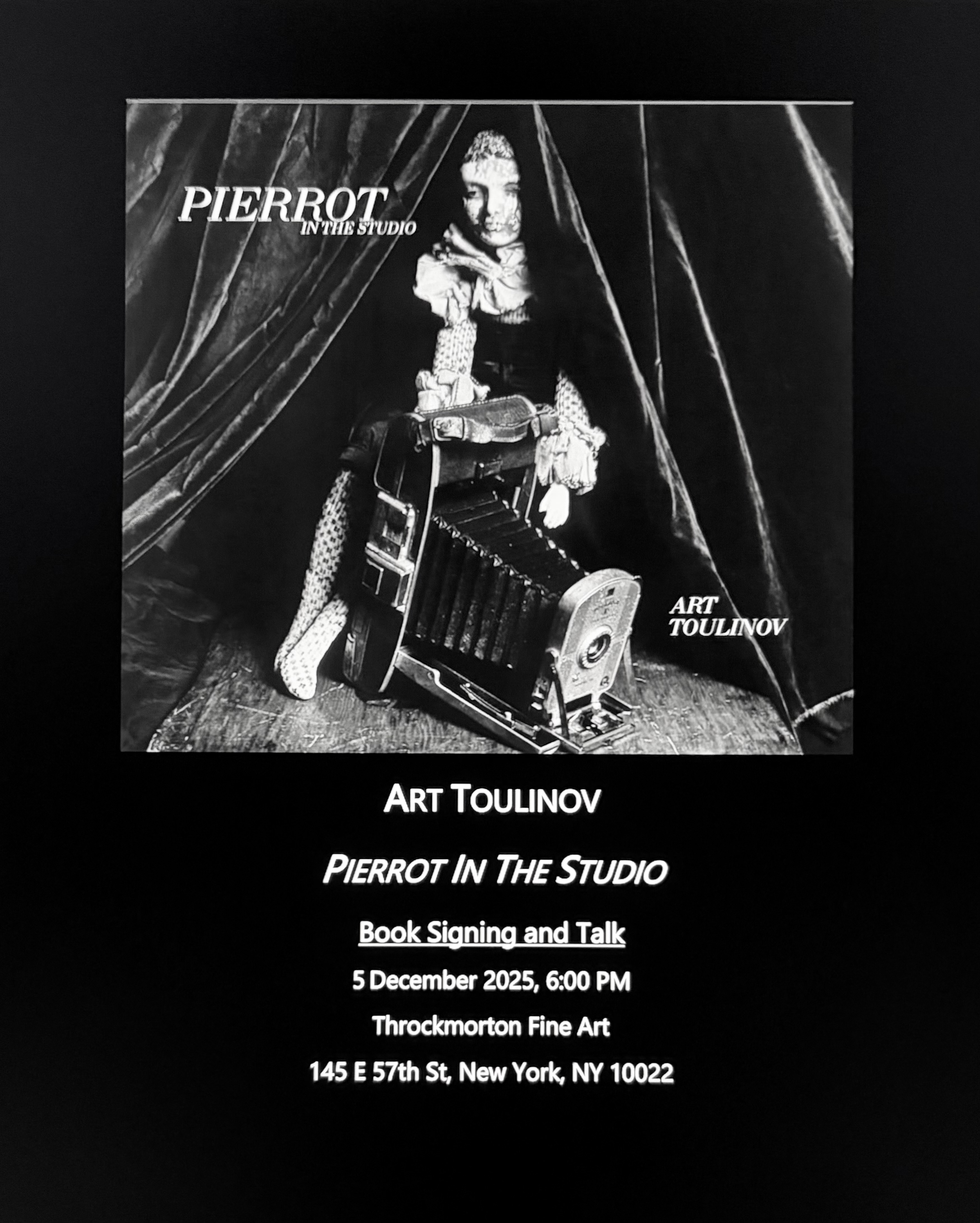
Over the years, more than 50 images were created. Could they become a book? Toulinov was fortunate to find a publisher for Pierrot in the Studio that understood his work with Pierrot even more than he did. When John O’Donnell of Atelier AVGI saw the images, his first thought was of a Japanese folklore, Tsukuyomi, meaning everyday household objects that have acquired a soul or spirit over a long time. The objects are believed to actually come to life and become self-aware and affect their owner depending upon how they are treated. If they are cherished, they become a helpful spirit; if neglected or mistreated, their spirit can become a menace to the owner. O’Donnell felt that Toulinov’s treatment of his puppets was transcendent, lifting them to the realm of the sublime.
Toulinov’s aged puppets are retired now, but the story of Pierrot and Columbine will live on. Their very human struggles are a part of us all. A free PDF of Pierrot in the Studio can be viewed on this link: https://www.blurb.com/b/12610178
Toulinov’s work is in the permanent collection of the Brooklyn Museum, as well as in many private collections. He has been exhibited in galleries throughout America, Canada and Europe, including some of the most prestigious galleries in New York, Los Angeles, and Monte Carlo. He is represented by Throckmorton Fine Art, LLC of New York City. https://www.arttoulinov.com/