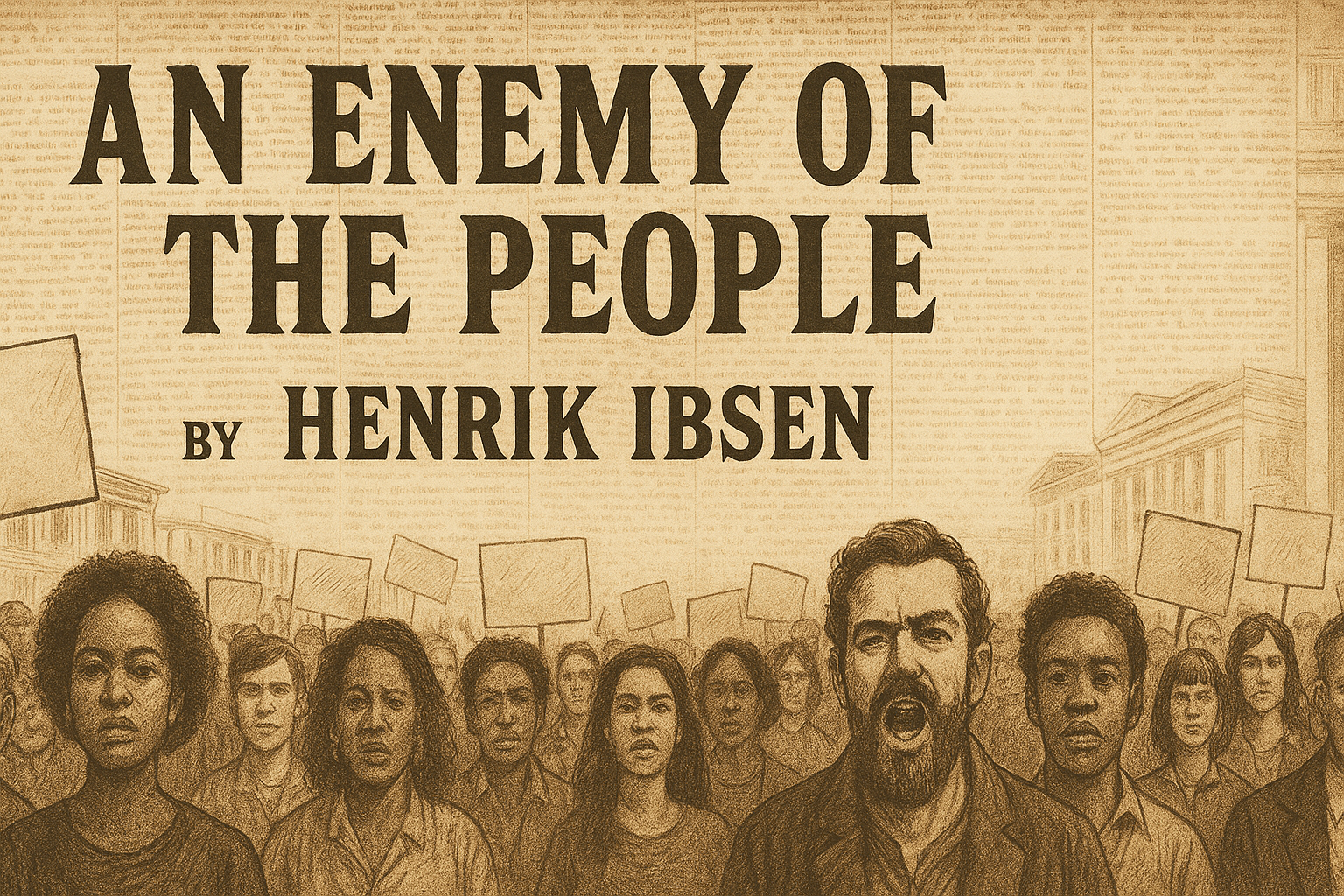
Classical Theatre, Comedy, and Kindness: The Quiet Mission of Duse Production of Ibsen’s An Enemy of the People, (Equity Approved Showcase)
We live in an age of yelling. The news yells at us. Social media yells at us. Strangers yell opinions from street corners, screens, comment sections, and headlines. Everything is urgent. Everything is loud. Even the noise of subway tracks feels relentless. Everything demands outrage.
Yelling does not necessarily sharpen attention; it can overwhelm it. It replaces listening with defense and reflection with survival. Because of that, one principle guided this production from the very beginning: we did not want to re-traumatize the audience by yelling at them. We all deserve more kindness than that. Theatre, at its best, is not here to mirror the world exactly as it is, but to suggest what we might become. We learn by watching. Babies and children know this instinctively – they absorb behavior, tone, and values through observation. If that is true, then we must ask why we continue to reproduce on stage the very traits we claim to want less of as a society.
The era of realism in acting served an essential purpose. It taught us how to listen, how to behave truthfully, how to inhabit another human being with care. But realism was never meant to be an endpoint. Now that we have learned its discipline, we must use that natural, fluid acting not to repeat the present, but to imagine the future. This production, is a reimagining of Ibsen’s An Enemy of the People an attempt to do exactly that. Anger is real, necessary, and justified – but it does not have only one volume. It does not need to arrive through shouting to be truthful. That is something many of us learned early, from voices like Mr. Rogers, who reminded us that strong feelings can be expressed with care, and that kindness is not the absence of truth, but the way truth becomes bearable.
So, when I began staging Henrik Ibsen’s An Enemy of the People, one question eclipsed all others: how do you tell the truth without becoming just another voice shouting in the noise Ibsen’s play is not subtle. It contains strong language, moral certainty, public confrontation, and righteous anger. Played at face value, it often becomes another experience of being shouted at – another moment where volume replaces care.
We refused to make that play. Not because the anger in the text is unjustified, but because force rarely invites listening. At Duse Productions, we chose an approach rooted in kindness – not avoidance or softness, but care. Care that allows difficult truths to be held without harm, and attention to remain open rather than defensive. The problem was never relevance. The problem was delivery.
Comedy as an Act of Respect
Our answer was comedy – not comedy as relief or irony, but comedy as respect. We took inspiration from heightened satire and forms like Saturday Night Live, where serious truths are carried inside humor. Comedy lowers defenses and creates space. It allows the audience to remain open long enough for difficult ideas to land. By leaning into larger-than-life characters, we entertain the audience while delivering deeply serious text. Laughter opens the body, and once the audience is open, the truth can arrive quietly and stay.
Comedy does not dilute Ibsen’s questions. It sharpens them. It exposes hypocrisy, fear, and self-interest without moralizing. The audience is not told what to think; they are trusted to arrive there themselves. That trust is essential.
Natural Acting and the Discipline of the Fourth Wall
Our style of acting is natural, in the lineage of Eleonora Duse. We do not perform for the audience. We rehearse deeply, rigorously, and privately, and the audience is invited to sit in. The fourth wall is not something to be smashed; it is a wall, and it exists to protect concentration. It allows actors to remain in genuine relationship with one another rather than turning outward to perform opinion or instruction. The audience’s presence is not assumed. It is a privilege. They are not asked to participate or instructed how to feel. They are allowed to watch. And in that watching, something essential happens.
The Audience as Artist
The audience brings their worries, exhaustion, happiness, and love into the room. Those energies are felt. The actors respond – not consciously or demonstratively, but truthfully. The work is created with the audience, not at them. This is where theatre becomes collective. The actors are not the artists; they are the vehicle, the paintbrush. The audience is the artist, using our bodies, voices, and attention to paint meaning together in real time. Interpretation does not belong to the stage. It belongs to the room.
This is why we refused to yell. Listening requires space.
Actors as Guardians of Attention
Actors are not interpreters; they are guardians of attention. Our responsibility is not to explain the text or impose meaning. The text has already survived more than a century. Henrik Ibsen does not need us to modernize him. Our task is to hold attention – fully, patiently, and generously – for as long as the play asks us to. To stay present, to stay precise, and to resist shortcuts. In older cultures, actors were not merely entertainers, but civic figures entrusted with holding space for communal reflection. That responsibility still exists, even if we have forgotten it.
Returning to the Source
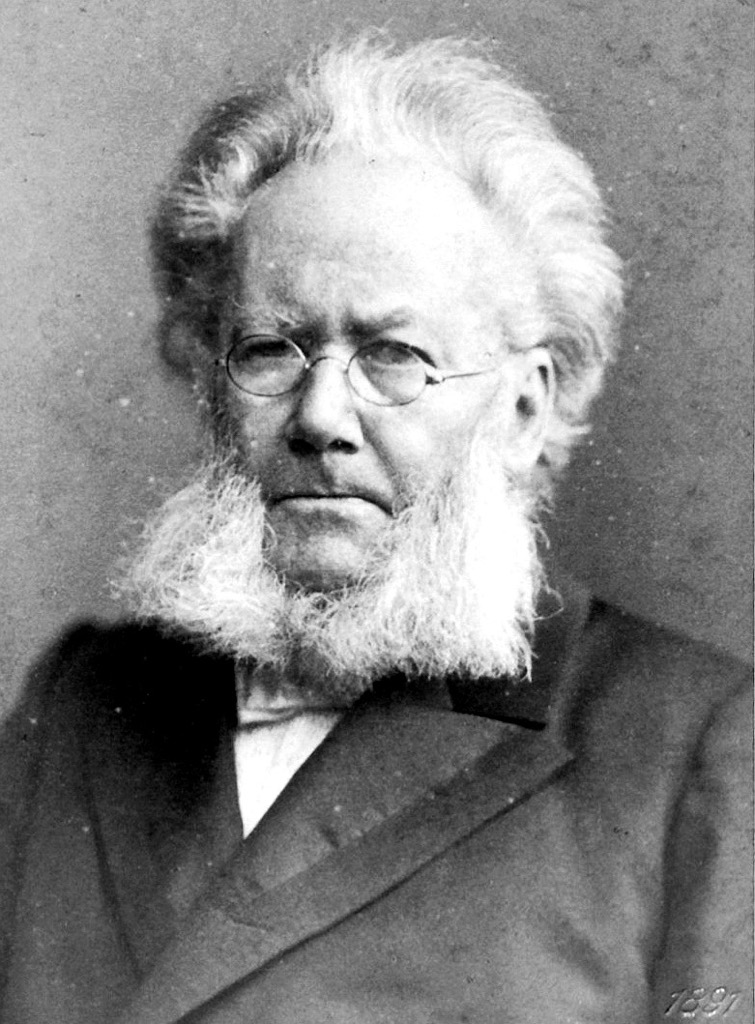
Rather than updating the play, we went closer to it. An Enemy of the People was first drafted and published in 1882, but for this production we worked from Ibsen’s 1897 Norwegian 2nd edition and the final version approved by Ibsen himself before his death in 1906. We created a new English translation specifically for this production, not to preserve the past, but to remove layers of accumulated interpretation. Ibsen does not instruct the audience what to think. He presents systems, exposes pressure, and allows contradiction to remain unresolved. The text does not need embellishment. It needs honesty.
Women, Equity, and Precision
The ensemble performing this production is predominantly women-led, intentionally so. Classical theatre has long offered women limited roles and restricted authority, and even today women are often asked to support narratives rather than carry them. We chose otherwise.
Women, in my experience, are often more sensitive listeners and more precise collaborators. They tend to hold contradiction without forcing resolution. When power is embodied this way, it becomes exact rather than loud.
Duse Productions is named after Eleonora Duse, an artist who rejected theatrical vanity in favor of truth, restraint, and inner life. Her naturalism was disciplined. She trusted silence, and she trusted the audience. That lineage matters.
Breaking Norms by Returning to Trust
At Duse Productions, part of our work is to quietly challenge industry habits that restrict creativity rather than serve it. One of the first norms we are addressing is the rigid relationship between a character’s written age or sex and the physical appearance of the actor portraying them. Too often, casting prioritizes surface resemblance over skill, as if theatre were a photographic medium rather than an imaginative one.
We chose a different approach. We cast actors based solely on their craft, presence, and ability to hold attention. We trust actors to transform – to carry age, authority, vulnerability, or power without relying on physical likeness – and we trust the audience to follow that transformation without needing literal confirmation. This is not a rejection of the playwright, but a return to the deeper agreement theatre has always made with its audience: that imagination completes what the stage suggests. When casting becomes too literal, imagination is impoverished. When actors are trusted, meaning expands.
Environment, Power, and Ibsen’s Clarity
At the center of An Enemy of the People is environmental contamination. The tannery poisons the water. The town knows. The town benefits. The town lies. Ibsen understood something we still resist acknowledging: environmental harm is tolerated when it supports economic comfort. Pollution becomes negotiable, truth becomes inconvenient, media is influenced, and fear is distributed strategically.
Climate collapse, water contamination, and industrial cover-ups are not new phenomena. They are recurring patterns. This is why the play continues to feel current. It deals with class division, political pressure, media influence, sexism, fearmongering, and the cost of telling the truth. Little has changed – except speed – despite the play having been written more than 143 years ago.
Where This Work Comes From
As a survivor of the 1992–1995 Bosnian war, I learned early what happens when truth becomes dangerous and fear replaces dialogue. I came to the United States in 1997 and grew up here, carrying both places with me. Those experiences did not make me louder; they made me more careful.
Over time, I became deeply committed to environmental responsibility, not as an identity but as a daily practice. I am vegan, and I think often about how our personal and collective choices affect the land, the water, and one another. Because of this, I am drawn to work that steadies rather than inflames – theatre that resists cruelty even in tone and chooses attention over aggression.
An Enemy of the People is often staged as a battle cry. For me, it is a warning and a plea for care – care for truth, for community, for the environment, and for one another. This production comes from a desire for peace, not victory.
Minimalism, Imagination, and Theatricality
The production is staged with a minimalistic design by choice. When excess is removed, imagination becomes active, and the audience becomes a collaborator in meaning rather than a consumer of spectacle. This approach draws from the work of Yevgeny Vakhtangov, a Russian theatre director and student of Stanislavski who believed realism should be infused with imagination, play, and heightened theatricality rather than confined to strict naturalism. In Vakhtangov’s vision, truth and fantasy coexist, allowing theatre to reveal deeper emotional and symbolic realities.
Paired with Eleonora Duse’s natural acting, grounded and human, this balance allows the work to remain truthful without becoming literal. Theatre does not need to overwhelm to be powerful. It needs clarity.
Duse Productions
This production is the first public work of Duse Productions. The company exists because we believe classical plays have not yet been fully listened to. We continue to write new work not because the classics are exhausted, but because we have not yet unlocked their full potential. Art is not disposable; it is cumulative.
Duse Productions is committed to returning to the source – Shakespeare, Chekhov, O’Neill, Euripides, Sophocles – and allowing these works to speak again without distortion. We are new, we are learning, and we intend to stay.
An Invitation
This is an invitation to share a room.
If you choose to come, you are coming to witness work in motion – to watch artists listening to one another, shaping something live, and allowing meaning to emerge in real time. You are invited to listen, to notice, and to reflect. Nothing more is asked. This production is intentionally small and intimate. It is an early expression of the work, before it grows, before it reaches larger stages. In this setting, the process remains visible, the air remains raw, and the exchange between actors and audience stays immediate.
For theatre enthusiasts, this is a chance to experience something uncommon: a classic play approached without spectacle or polish, offered at a moment when it is still discovering itself. The intimacy allows for risk, honesty, and a kind of presence that larger spaces rarely permit. What we are offering is not a finished statement, but a living encounter – one that exists only in the room, with the people who choose to be there. We believe shared attention still matters, and that this early, close proximity is where that attention can be felt most clearly.
Closing
We refuse to yell at the audience because yelling is easy. It is easy to demand attention, to frighten people into staying, or to hold a room through force, volume, or pressure. What is harder is vulnerability – standing quietly in front of others and trusting that, if we listen deeply enough and work honestly enough, they will choose to stay, not because they are compelled, but because they want to.
Our aim is not to trap the audience in their seats. It is to share something rooted in care. We try to show love on stage through the love we find in the work itself – through attention, discipline, humor, and presence. From that place, we hope the audience is reminded of their own capacity for love – for themselves, for their neighbors, for family, and for people in need.
This is why we aim to make work that welcomes everyone, where different generations can sit in the same room and no one is talked down to. If theatre can still do anything, it is to create a space where attention becomes love and love becomes responsibility. Theatre is not here to show us reality as it is, but to remind us of what we are capable of becoming. It exists to raise the bar of our shared humanity and to invite us to raise it together.
We chose the harder path – the quieter one, guided by kindness and love. It requires patience, trust, and the courage to believe that care can carry truth further than volume ever could.
That is why we refuse to yell. And that is the work we aim to do.
An Enemy of the People (2026), By Henrik Ibsen, (Equity Approved Showcase)
Dates: January 28 – February 8, 2026
Venue: American Theatre of Actors (ATA)
Address: 314 w 54th St, New York, NY10019 [maps]
General Admission: $45
(Tickets are fully refundable up to 24 hours before performance)
https://www.duseproductions.com/on-stage